My visit to Manila: some thoughts on the approach to tell Hong Kong stories well
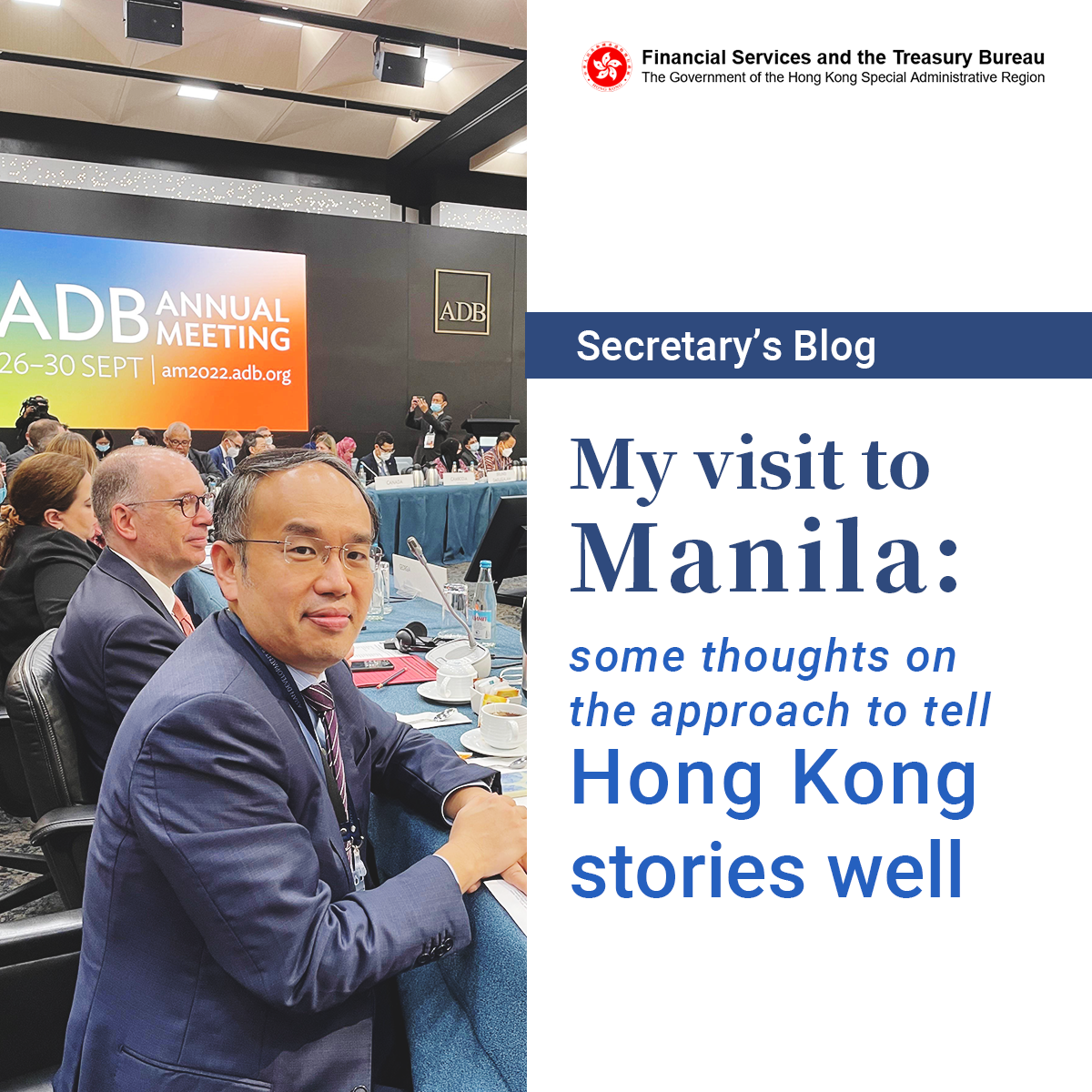
Last week, I visited Manila, the Philippines to attend the annual meeting of the Asian Development Bank (ADB) as a representative of Hong Kong to discuss with participants from around the world about the ways to promote the post-pandemic development of green economy. In the face of numerous issues such as global pandemic, climate warming, supply chain constraints and elevating inflation, ADB is determined to carry out reforms on its energy policies, capital investment and organisational structure, with a view to developing a new model for sustainable development in Asia in collaboration with its members. When speaking at the annual meeting and interacting with individual participants, I took the opportunity to promote Hong Kong as an international financial centre by introducing the full spectrum of our professional services (covering offshore Renminbi (RMB) finance, green and sustainable financing, fintech solutions and risk management tools), and to encourage ADB and its partners to tap into the new opportunities in Hong Kong. During my visit, I also met with the government officials of the Philippines, including the Senate President as well as representatives of the Department of Finance, the Bangko Sentral ng Pilipinas and the Department of Foreign Affairs, to explore future collaboration between the two places. I have particularly deep feelings about this visit, as it coincided with the launch of the new “0+3” anti-epidemic measure in Hong Kong to strengthen our connection with the rest of the world. I have also gradually devised my own approach to tell Hong Kong stories well, which I am going to share with you.
1. Highlighting our unique advantages: During my recent visit to Manila, I strived to promote to ADB members (including the Philippines) our financial advantages as the largest offshore RMB centre in the world. In fact, the Government of the Philippines has previously issued “panda bonds” (i.e. onshore RMB bonds), for which international investors could subscribe directly via the Northbound Trading of Bond Connect launched in Hong Kong. Looking ahead, through the communication network established during the visit, we will actively encourage institutions across Asia to deeply explore Hong Kong’s RMB services, including trade settlement, financing, green finance and risk management, with a view to creating a win-win situation for all parties and contributing to the internationalisation of RMB.
2. Presenting solid evidence: As the pandemic has made it difficult for us to communicate directly with our overseas partners for some time, the international community might not have a clear understanding of Hong Kong’s current situation and future development directions. By leveraging the opportunities arising from the new “0+3” anti-epidemic measure, we should present Hong Kong stories well with solid evidence and “let figures speak for themselves”, exhibiting our unique edges under “One Country, Two Systems”. As the international representatives participating in the ADB event were particularly concerned with the post-pandemic recovery of green economy, I gave an account of Hong Kong’s advantages and commitments in developing green and sustainable finance with specific targets and figures, highlighting the latest developments such as our pledge to achieve carbon neutrality before 2050, injection of HK$240 billion to combat climate change in the coming 15 to 20 years, issuances of green bonds totalling about US$10 billion by the Government, and arrangement for issuing US$31.3 billion worth of green and sustainable bonds in Hong Kong last year (accounting for one-third of the market share in Asia).
3. Adopting a sentimental approach: The Philippines and Hong Kong have all along been maintaining close and frequent people-to-people and cultural exchanges. Many local people there told me that Hong Kong was one of their favourite travel destinations, and that they missed the delicacies and tourist attractions of Hong Kong. During the conversations, I deeply realised that the exchanges between two places were inseparably linked to the forging of bonds of friendship as well as the fostering of a profound understanding of each other’s culture and feelings.
While the policy areas of the Financial Services and the Treasury Bureau (FSTB) are mostly related to figures, we also promote policies and make legislative amendments from the perspective of benefitting the public through financial measures. Currently, nearly 200 000 Filipino domestic helpers are working in Hong Kong. Sometimes they might resort to borrowing loans to tide over financial difficulties. However, they might not be able to receive proper protection in this regard due to inadequate information, and might consequently be subject to hefty interest payments, which would make them feel helpless on foreign soil. In response to the public concern over the excessively high interest rates charged by money lenders in recent years, FSTB proposed to the Legislative Council (LegCo) in mid 2022 amendments to the Money Lenders Ordinance to lower the statutory interest rate cap and the extortionate rate. Subject to the passage of the amendments, which are being under LegCo’s scrutiny, the new interest rate cap will be implemented with effect from 30 December 2022. For more effective protection of borrowers, the Police will step up prosecutions against the deceiving acts of non compliant money lenders and financial intermediaries, while FSTB and other relevant agencies will continue launching publicity campaigns on prudent borrowing. I also wrote to inform the Philippine Consulate General in Hong Kong of our proposed legislative amendments while expressing our hope that local immigration authorities in the Philippines would convey in advance the relevant message to those domestic helpers going to Hong Kong and alert them on the new maximum interest rate chargeable by money lenders, so that they could avoid incurring heavy debts. Besides, since the enactment of the Payment Systems and Stored Value Facilities Ordinance, Hong Kong has seen a mushrooming of payment instruments such as e wallets under a clearer and more specific regulatory regime. These payment instruments provide more convenient, efficient and reliable financial services, including cross border remittances, to citizens and foreign domestic helpers, contributing to financial inclusion.
After coming back from the Philippines, I am now preparing to attend the Asia Pacific Economic Cooperation meeting in Thailand in late October, during which I will continue to tell Hong Kong stories well by highlighting our unique advantages, presenting solid evidence and adopting a sentimental approach. Currently, the world is undergoing tremendous changes unseen in a century, with geopolitical situation presenting various challenges to globalisation. At this very moment, the world desperately needs a flexible and versatile “global connector” more than ever, and it just so happens that Hong Kong is capable of playing such an important role to connect all parts of the world and open up new prospects with an innovative mindset.
5 October 2022