 |
|||||||||||
|
 The
Marine Department shares with us how it responds to the challenge of
achieving the EPP targets. Their plan includes Process-Reengineering
and Better Utilisation of Human Resources. It would offer accelerated
deductions of 3.1%, 3.4%, 3.5% and 5% cumulatively for the years 1999-00,
2000-01, 2001-02 and 2002-03 respectively.
The
Marine Department shares with us how it responds to the challenge of
achieving the EPP targets. Their plan includes Process-Reengineering
and Better Utilisation of Human Resources. It would offer accelerated
deductions of 3.1%, 3.4%, 3.5% and 5% cumulatively for the years 1999-00,
2000-01, 2001-02 and 2002-03 respectively.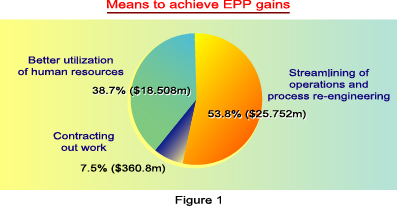 |
(i) Contracting Out Work
The Government Dockyard (GD) operated on an establishment of 1 Head Property Attendant (HPA) and 17 Property Attendants (PA) who provide round-the-clock security service to GD. Another 2 PA posts were made available upon the taking-over of the ex-Tamar site from the Government Property Agency (GPA) in April 1999.
According to the current contract awarded by GPA, the annual cost for engaging security guards to look after the ex-Tamar site on a 24 hours basis is $424,800. If similar service is to be provided by PAs, 8 posts with a total NAMS value of $1,035,360 ($129,420 x 8) are required. It is obvious that hiring of private security service to replace the PA posts is more cost effective. To avoid causing any redundancy, the introduction of private security service will be implemented in stages, congruous with the natural wastage of the PAs. In the year 2000-01, the day-shift security services (i.e. from 7:00 a.m. to 7:00 p.m.) will be contracted out and 6 PA posts will be deleted. Private security service will be progressively implemented to tie in with the natural wastage of PAs in the subsequent three years. By the year 2004, only 1 HPA and 8 PAs will remain and they will be assigned to supervise the services performed by the private security company and to take up part of the night-shift duties. In the year 2000-01, in addition to savings accrued from hiring of private security services, $357,000 on overtime allowance will be saved because PAs will no longer be required to work overtime to cover urgent or ad hoc assignments.
(ii) Streamlining of Operations and Process Re-engineering
Measures introduced included a de-merit system for the maintenance contractors of GD, spacing out the interval of buoys maintenance and carpark automation in Public Cargo Working Areas (PCWA).
(a) Since it has been the practice for the GD to accept the lowest tender for repair and maintenance work, it would be unfair to those contractors who have quoted a higher price but are able to provide better quality service. The de-merit system is proposed to upgrade the quality of maintenance contractors' performance in the GD. The principle of the system is similar to the point system of driving offences. It is an open, transparent and fair mechanism to penalise contractors with poor performance. The successful implementation of this system will result in a reduction of rectification work after completion of contract and consequently reduce the expenses involved. It is envisaged that the system will yield a savings of $0.63 million in the fiscal year 2002-03.
(b) As a result of the stepping up of harbour patrol services and the introduction of pro-active traffic management measures, the vessel traffic flow in Hong Kong waters has become much better regulated and organised. The interference with buoys by vessels i.e. ramming and bunching, has been significantly reduced resulting in less damage and in turn less maintenance required for the buoys. After review, it was concluded that the interval of regular maintenance can be reduced from once every 12 months to once every 16 months, producing an annual savings of $5.24 million.
(c) Currently, Cargo Handling Assistants (CHAs) (Artisans) are deployed to man the gates of Public Cargo Working Areas (PCWA) to control vehicular entry and exit. Instead of using manual control, the Department will install automatic gates in 4 PCWAs in 1999-2000. A total of 15 CHA (Artisan) posts will become surplus and a staff savings of $2.267 million will be effected. Discounting the capital installation and maintenance cost of the automatic gates, the Department will be able to save up to $1.5 million per year on staff cost. Arrangements have been made for the surplus staff to transfer to the Launch Assistant (LA) grade in the Government Fleet Division of the Department. Three rounds of in-service recruitment exercises had been conducted and the Department will be able to absorb all displaced CHAs into the LA grade before the end of the current financial year. With these measures, the department is able to satisfactorily take care of the surplus staff in PCWAs without causing any redundancies.
| (iii) | Better Utilisation of Human Resources through Re-organisation, Simplification of Processes and Merging of Under-Utilised Services |
In order to assess the suitability of the existing staff complement for the work assigned and to maximise utilisation of existing staff resources, the department has conducted a series of reviews on the existing manpower requirements of the Harbour Patrol Section, the Vessel Traffic Centre and the Ma Wan Local Control Station. The reviews concluded that with the actual operating experience in the past few years, a number of posts can be downgraded without jeopardising the quality of service. This has been made possible with the provision of proper vessel services training to staff, the establishment of a set of operational guidelines and procedures, and closer and more efficient supervision and monitoring of staff performance. As a result, considerable staff savings have been effected, examples of which include :-
| (a) | deletion of 4 Marine Inspector II posts in the Vessel Traffic Centre; |
| (b) | downgrading 5 Marine Controller posts to Assistant Marine Controller at the Ma Wan Control Station; |
| (c) | downgrading 5 Marine Inspector I posts to Marine Inspector II for manning the patrol launch in the Ma Wan and Marine Exclusion Zone areas; and |
| (d) | downgrading 5 Assistant Marine Controller posts to Marine Inspector II in the Harbour Patrol Section. |
All displaced staff are deployed to fill newly created posts for new services and projects, the most important of which are the establishment of the new Kwai Chung Local Marine Traffic Station at Container Terminal 8 and the strengthening of manpower support for inspection duties in the Dangerous Goods and Projects (DGP) Section. Staff involved include officers in the ranks of Marine Controller, Assistant Marine Controller and Marine Inspector I. The deployment of displaced staff has therefore effected productivity enhancement by providing the necessary manpower for new or improved services.
Under the EPP, the Marine Department has effected an overall savings of 81 posts, 13 of which are at the senior level (mid-point at MPS 34 or above), 25 at medium level (mid-point at MPS 10 to 33) and 43 at junior level (mid-point at MPS 9 or below). To ensure that all displaced staff are gainfully deployed and that no staff will be made redundant, deletion of posts are restricted to newly created but unfilled posts and the actual deletion is scheduled to tie in with the retirement dates of outgoing officers and the creation of posts for new projects.
EPP is a shared endeavour and its success rests on staff understanding and support. With continued staff co-operation, the Marine Department will try its best to deliver the pledged productivity gains in the short-term as well as sustained improvement in the longer-term.